
Products
Prepare the concrete (Base Layers)
Seal & bond (Surface Barrier)
Protect & finish (Topcoats & Sealers)
Complete systems (Multi-Layer)
Technical detail (Long Form)
Prepare the concrete (Base Layers)
Seal & bond (Surface Barrier)
Protect & finish (Topcoats & Sealers)
Complete systems (Multi-Layer)
Technical detail (Long Form)
Technical detail
What the product is and why it works lives on the product page. This is the document set behind it: the tested numbers, the approval, the installation instructions, the CSI section, and four projects that have been in service long enough to be worth looking at.
Looking for the overview instead? Read the short form on the CeramycGuard product page.
CeramycGuard™ is a Ceramic Surface Treatment for concrete: an inorganic, nanoscale alumina-zirconia-silicate polymer supplied as a one gallon, three part kit, made up of a Part A Liquefier, a Part B Ceramic Powder and a Part C Densifier. It is mixed on site and applied by roller or brush, or by squeegee and back-roll on horizontal work. It is water based, it has no flash point, and it cleans up with water. Weight solids are 80 percent, plus or minus 2 percent, and a gallon weighs 17 lb.
Only a single coat is required to reach the stated properties, and the material does not shrink as it dries. Dry film thickness is 7 to 9 mils, which is 175 to 225 microns. The recommended coating system for concrete is Ceramic System PoreBlocker™ as a penetrating treatment at under 1 mil, followed by CeramycGuard at 7.0 to 9.0 mils. Manufacture generates 8.33 pounds of carbon dioxide per gallon, and a gallon covers about 200 sq ft. CeramycGuard carries a 25 year non-disbondment warranty.
Pull-off adhesion under ASTM D4541 is greater than 1000 psi, and the failure occurs in the concrete rather than at the bond, which is the result a specifier actually wants: the weakest point in the assembly is no longer the treatment. Shore D hardness under ASTM D2240 is 83, plus or minus 5. Thermal cycling under ASTM D6944 recorded no checking, no cracking and no blistering. Advanced weathering across UVA, UVB and UVC wavelengths recorded no chalking, no cracking and no delamination. Fire testing under ASTM E84-15b recorded a flame spread of zero and smoke generation of zero. Abrasion testing under ASTM C779 Procedure A recorded a surface abrasion reduction of 50 percent or more at the 30 minute interval, and Taber abrasion under ASTM D4060, CS-10 wheel at 1000 g load, recorded a wear index of 17 per 1,000 cycles.
Miami-Dade County issued NOA No. 24-0626.03 for CeramycGuard as an inorganic polymer concrete coating and anti-salt corrosion barrier. It was approved on 1 August 2024 and expires on 28 March 2029, and it revises the earlier NOA 23-1212.01, which is superseded and should not be cited. The NOA describes the material as a nano-ceramic inorganic polymer on a concrete substrate, applied by brush and roll, or by squeegee and back roll on horizontal surfaces. It records Shore D hardness of 83 under ASTM D2240, pull-off adhesion of 568 psi with concrete substrate failure under ASTM D7234, and 100 day accelerated weathering under ASTM D5894 (modified) with no damage or disbondment. It lists a missile impact rating of None, and it carries one explicit limitation: the product has not been tested for water infiltration. The approval covers CeramycGuard specifically and does not extend to other products in the range.
At a technical glance
Application
Two installation instruction sheets cover this product: the standard CeramycGuard CST sheet and the CeramycGuard Black Diamond sheet. Both are linked at the foot of this page, and an applicator should be working from the one that matches the kit in front of them.
Preparation comes first and it is not the part to compress. The concrete must be free of every foreign or unsound material: organic coatings, paints, oils, residues, dirt, dust, debris, and anything else that acts as a bond breaker. Any organic product previously used for crack repair has to be excavated rather than coated over. Loose debris and loosely attached aggregate come off, and the recommended method is pressure washing with a spinning surface cleaner head so that debris and chemicals are actually removed rather than moved around. Where a colloidal treatment has already gone down, a light pressure wash or an auto-scrub is enough to take off construction dust and soil. On a restoration job, the profile and the means of mechanical preparation are set by the state of the existing substrate, not by a default.
Mixing is a sequence, not a stir. Part A goes into the pail first, in full. The Part B powder follows slowly, never more than half a bag before mixing, with the drill running at maximum RPM throughout, and every quarter bag fully integrated before any more is added. No more than three gallons are mixed at once. Once there are no lumps, mixing continues for at least another 60 seconds, then the Part C Densifier goes in and gets a further 60 seconds. Black Diamond adds one step in the middle: its bag goes in after the Part B powder is fully integrated and before Part C, with its own 60 seconds at maximum RPM. Some black particulate is expected in the mixed material.
The envelope in the panel below is not advisory. Applying below 55°F, above 85°F, within 5°F of the dew point, or with rain forecast inside 24 hours is how a good product is made to look like a bad one.
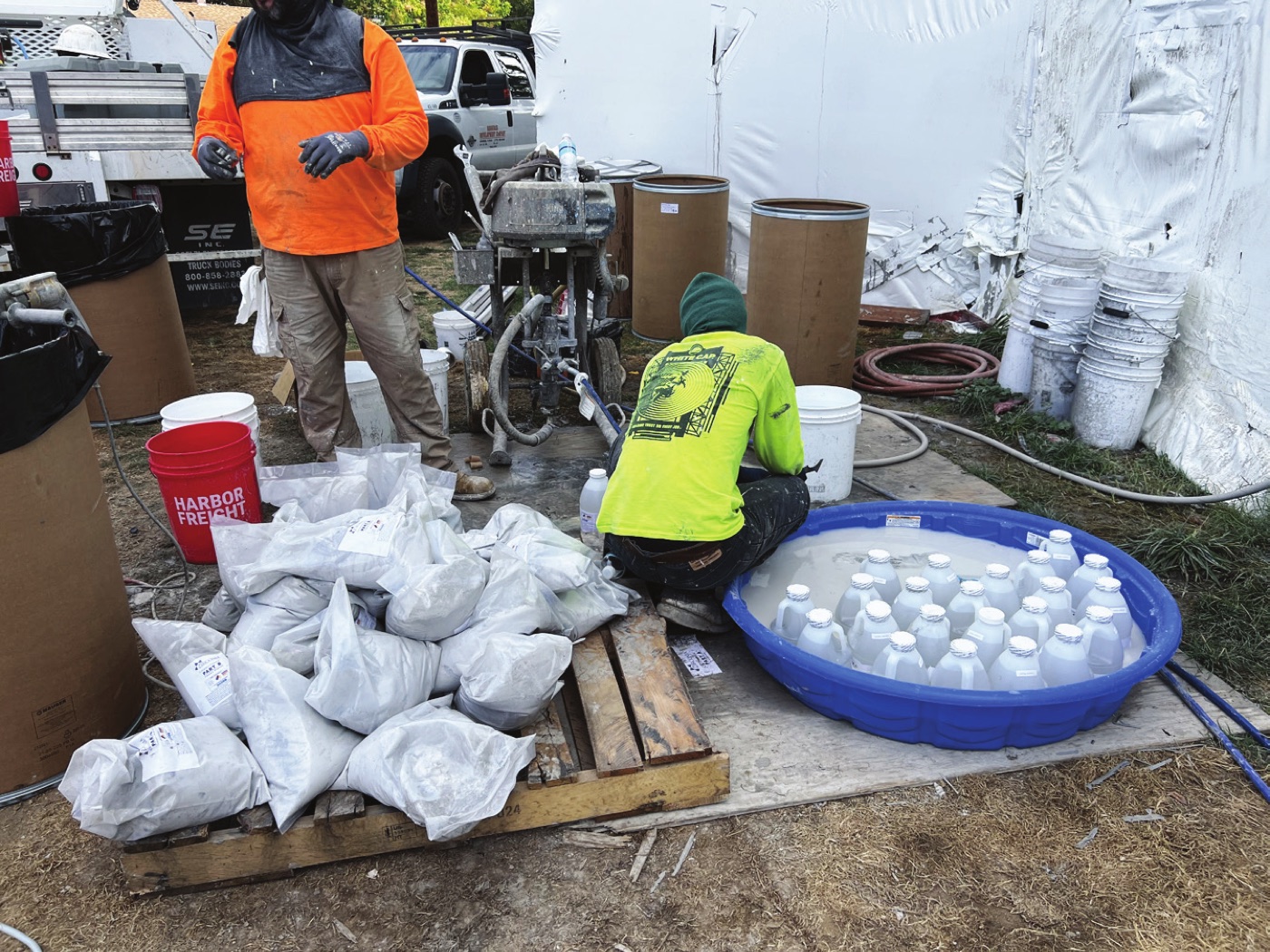
The material is an irritant to skin and eyes, so gloves and eye protection are required, and hydrocarbon solvents must never be used for cleaning the substrate. Refer to the safety data sheet before use.
CeramycGuard is written to CSI Section 09 96 70, Concrete Ceramic Surface Treatment, and the full specification is linked below in the form a project manual can take directly. The recommended uses in that document are infrastructure rather than architectural finishes: bridge substructure beams, piers and abutments, dams, tunnels, parking garage decks and walls, retaining and sound barrier walls, seawalls, wharfs and quays, wastewater treatment structures, cast concrete products, and CMU block walls.
The specification records LEED 4.2 Low-Emitting Materials compliance, and states that the product complies with all Federal and State VOC requirements. It also carries the abrasion results under ASTM C779 and ASTM D4060 quoted above, which is usually the section a specifier turns to when the surface will see traffic.
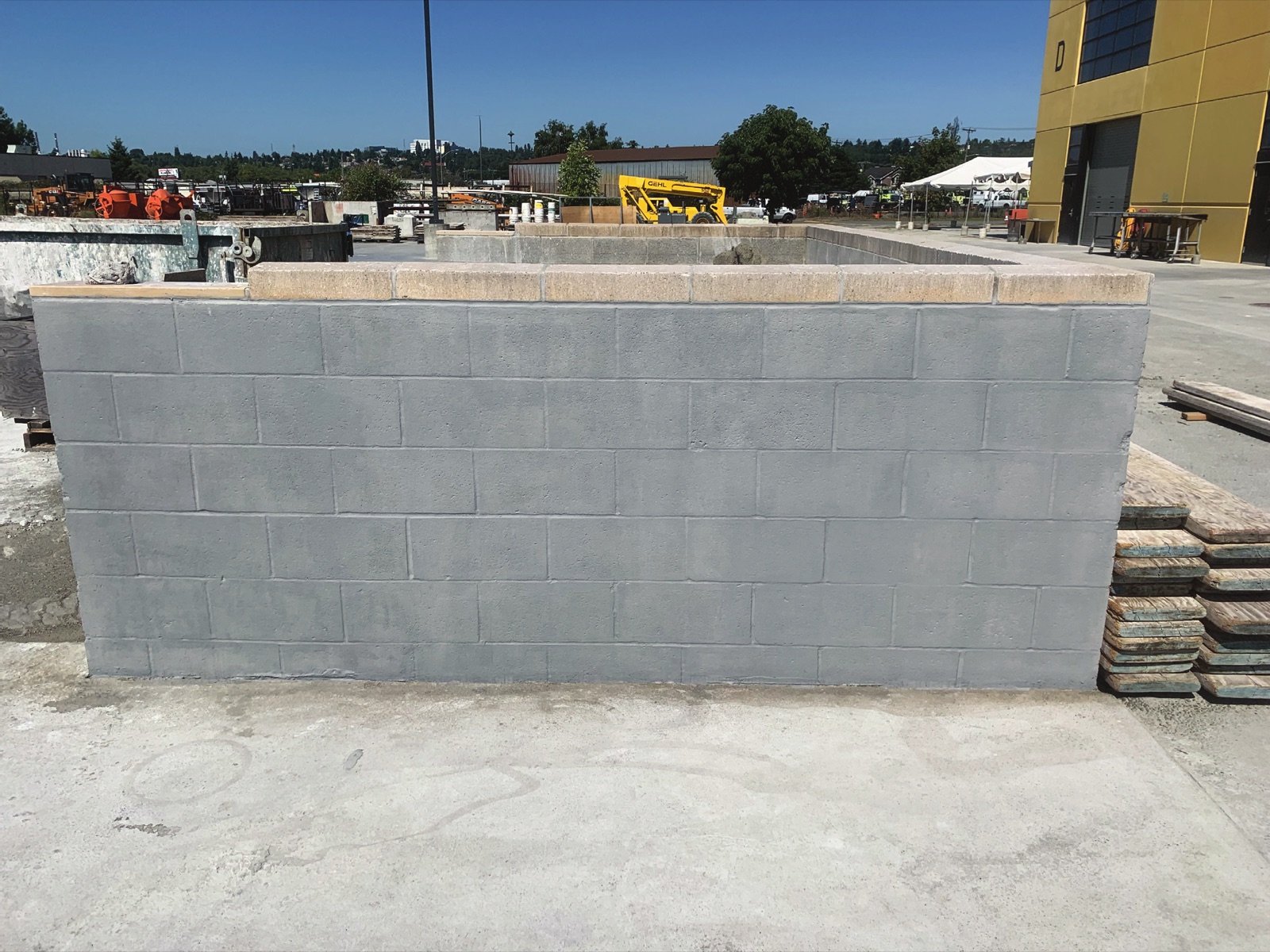
On CMU block, one detail is worth pulling out of the recommended-use list, because getting it wrong is expensive. A hybrid topcoat is never applied to block on its own: CMU is high-porosity with patchy surface calcium, so it consumes the topcoat before a continuous bond forms. CeramycGuard goes on first to mineralize the face, and the topcoat locks into that.
Project spotlights
Each of the four has its own downloadable spotlight, linked below. What follows is what is in them.
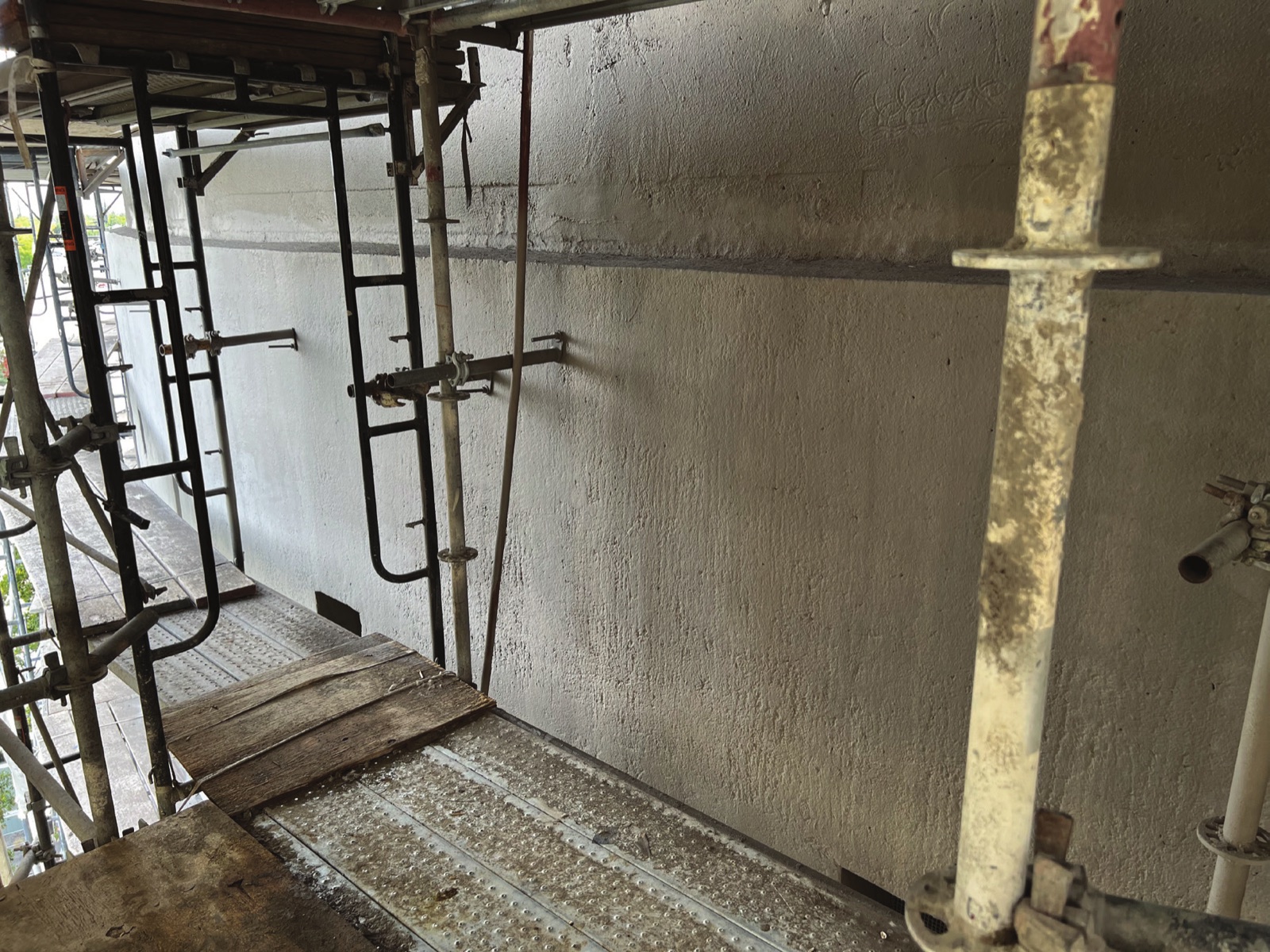
A twelve story concrete reservoir built in 1939, seismically reinforced with an outer jacket in 1996, holding three million gallons and supplying the surrounding community including UC Davis Medical Center. By its eightieth year it was showing advanced corrosion, and the 1990s jacketing was in worse condition than the 1930s concrete underneath it: binder lost across both sections, a highly porous surface, rebar spalling, lowered pH inside the concrete, and vertical and diagonal cracking every six to twelve inches. Demolition and replacement were prohibitive, in cost and in lost water capacity.
The treatment replaced the lost cement binder rather than covering it. Nanoscale ceramic particles penetrated the pores and cracks, reacted with the calcium hydroxide and other alkali elements in the concrete, and re-bonded the cement, sand and aggregate into a continuous surface. The corrosion was reversed. The finished structure does not look factory new, and the spotlight says so; what it has is a sound, sealed, thermally compatible surface that is unaffected by carbonic acid in rainwater, on a structure that would otherwise have been written off. Two further Sacramento reservoirs are future work, not completed projects.
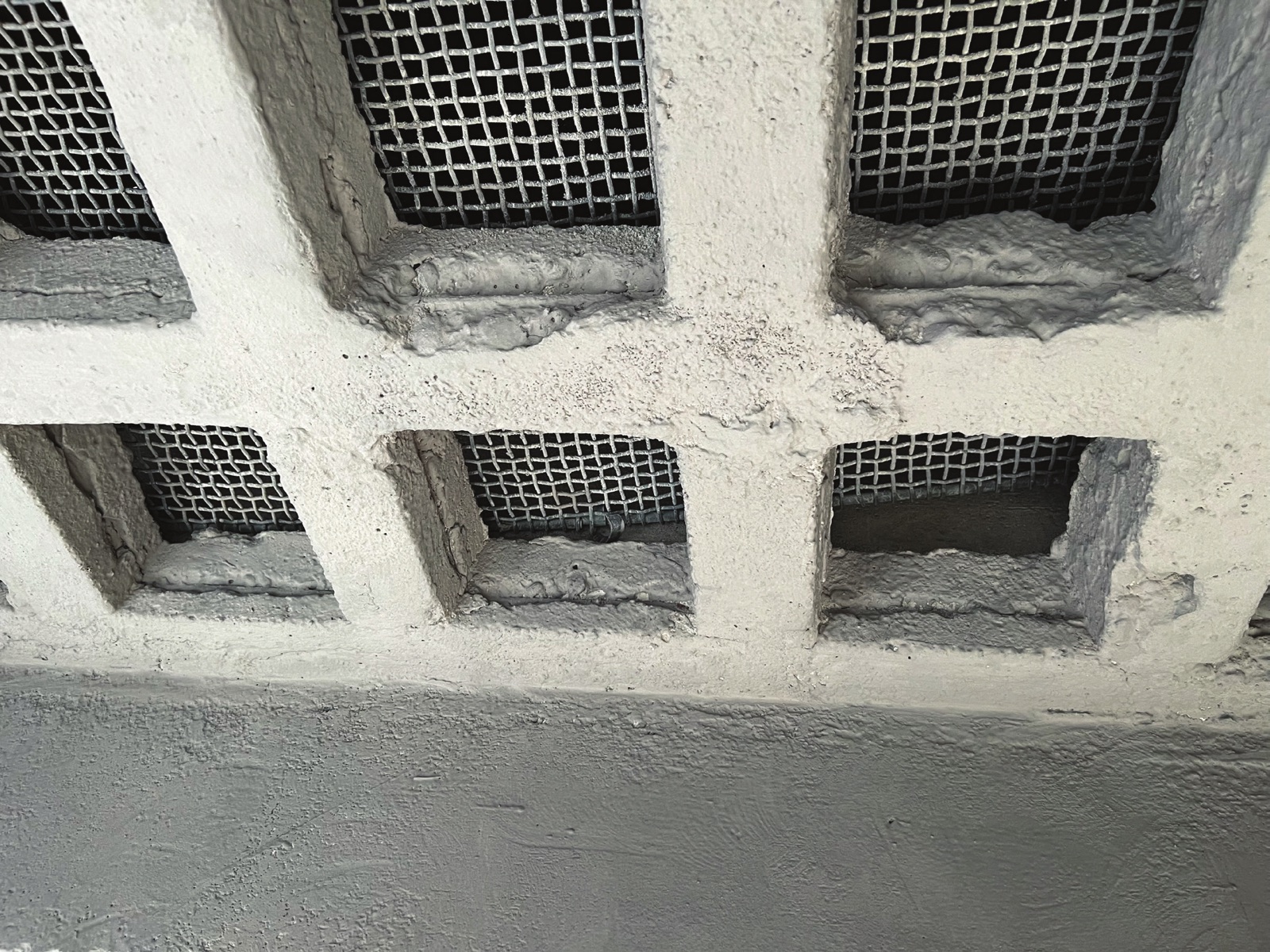
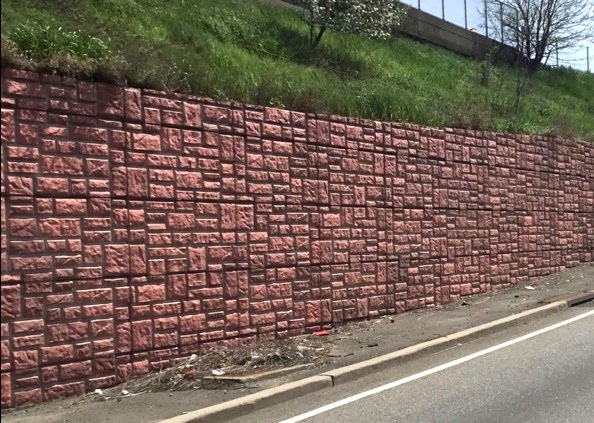
Two structures in New Jersey, in an environment that runs the full corrosion menu all year: freeze-thaw cycling, de-icing salt on the roadway, and humid summers that encourage algae and fungi and the bio-acids that come with them. A bridge abutment in Burlington County was treated in 2007 by Rutgers University and photographed in 2017, looking new at ten years. A support wall where Route 280 meets the Garden State Parkway was treated by the New Jersey Department of Transportation in 2008 and photographed in 2020, looking new at twelve years. The abutment is grey and the wall is red; the color is the paint the DOT put over the treatment, not the treatment itself. There are two of these walls, one red and one grey.
The mechanism in the spotlight is the same one the product page sets out: the previously porous, chemically unstable concrete surface is now a dense, continuous ceramic composite, breathable but not porous, so the salts that would normally travel in through surface pores and capillaries no longer have a route.
Four data center projects, protecting concrete near high-voltage transformers and electrical equipment. In Silicon Valley, a warehouse converted into a data center had air conditioning units on the second floor sitting directly above first floor servers, on a poorly installed deck with extensive shrinkage cracking, and water leaking from the units above. The deck was ground to CSP 3 and pressure washed, every shrinkage crack was filled with CeramycGuard, the overfilled cracks were ground flat the following day, the deck was auto-scrubbed and then coated. The acceptance test was a ponding test: an area of the second floor was flooded with water, directly above the servers, and no moisture came through.
Three further facilities on the Columbia River in Central Oregon needed concrete sealed near louvered walls that let moisture and large temperature swings into the space, with 750,000 volt lines from hydroelectric dams entering the buildings. Because the bond is chemical rather than mechanical, the newly placed concrete needed no extensive grinding: it was bull-floated flat, left open and porous, and coated at 8 mils. The material is an electrical insulator, it is not conductive and it is not combustible. The saving on surface preparation alone ran to hundreds of thousands of dollars, and the water-based chemistry meant an occupied facility was not filled with solvent vapor to get the work done.
This spotlight is filed with the CeramycGuard documents, and it is worth being straight about why it is here: it is not a CeramycGuard project. Columbia Distribution, a major beverage distributor in Springfield, Oregon, had already replaced a slab around a product disposal area after leaking sodas and juices ate it away, and wanted the replacement protected, easy to clean and non-slip. The specification for that is Ceramic System PoreBlocker™ to densify the concrete and cut its capillary void space, with a BulletProof™ hybrid topcoat over it for chemical and wear resistance.
It is included in this document set because it answers a question specifiers ask early: what happens when the exposure is standing organic acid on a traffic floor rather than salt, carbonation and weather on a structure. The answer is a different stack, and the spotlight is linked below with the rest.
Product documents
Application and specification
Questions
The CSI specification, because it is already written in the section format a project manual uses: Section 09 96 70, Concrete Ceramic Surface Treatment. The Technical Data Sheet sits behind it for the numbers, and the Miami-Dade NOA is the regulatory record. All three are linked on this page, along with the mixing and installation instructions the applicator will need on site.
Miami-Dade County issued NOA No. 24-0626.03 for CeramycGuard as an inorganic polymer concrete coating and anti-salt corrosion barrier, approved 1 August 2024 and expiring 28 March 2029. The NOA covers CeramycGuard specifically, and it records a missile impact rating of None and states that the product has not been tested for water infiltration. We cite it as a factual approval, never as an endorsement.
Black Diamond is a variant with an extra component, supplied as its own bag. The preparation, the cleaning, the mixing discipline and the cure schedule are the same; the difference is one additional mixing step, where the Black Diamond bag goes in after the Part B powder is fully integrated and before the Part C Densifier, with another 60 seconds at maximum RPM. It has its own installation instruction sheet, linked below, and that is the document an applicator should be working from.
No. The scope is concrete. Zirconia does not offer a product for application to steel, and no bonding claim to steel is made. What CeramycGuard does for reinforcement is indirect: the cement binder degrades before the reinforcement corrodes, so protecting and rebuilding the binder is what keeps the embedded steel passive.
Less than an organic system needs, because the bond is chemical rather than mechanical. The requirement is a clean, sound substrate free of coatings, sealers, oils and any other bond breaker, prepared to SSPC-SP13 / NACE 6 or ICRI No. 310.2R, CSP 1-3, with a minimum CSP 1-2 profile, and Saturated Surface Dry or drier. On newly placed concrete that can mean nothing more than a light float finish left open and porous, with no grinding at all.
Send us the structure, the exposure and the condition of the concrete, and our technical team will come back with the stack and the coverage.