Prepare the concrete

Ceramic System PoreBlocker™ Concrete Pretreatment

An alumina-doped colloidal silica treatment for existing and aged concrete that penetrates deep into the capillary system, rebuilds the binder, and seals the pore network so Zirconia's ceramic coatings can bond to a stronger surface.

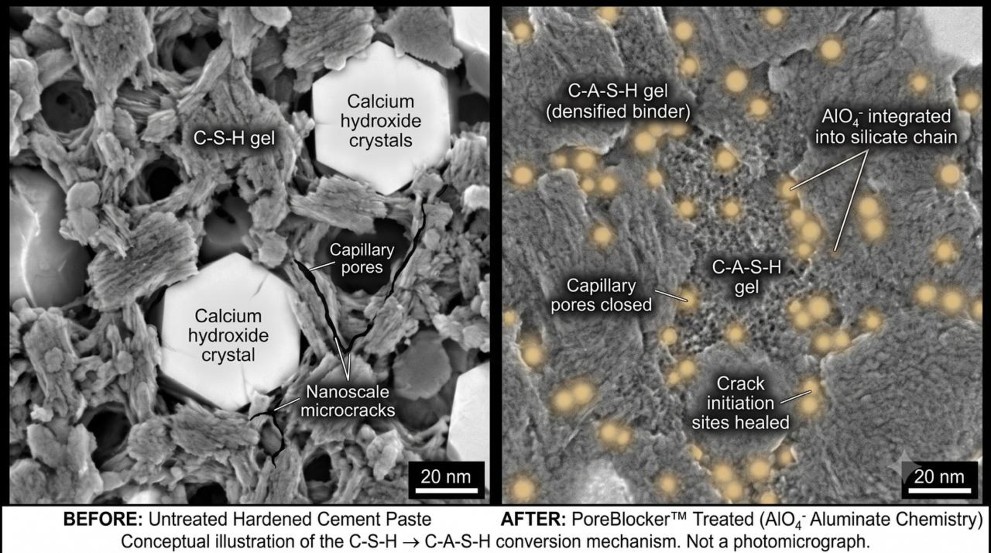
PoreBlocker penetrating concrete treatment, untreated versus treated cement paste illustration

Before and after PoreBlocker™ treatment (conceptual illustration).

Rebuild existing concrete. Maximize protection.

Concrete's capillary pore network is the pathway for water, chlorides and contaminants to reach the cement binder and the reinforcing steel. Ceramic System PoreBlocker™ (CSPB) penetrates and seals that pathway. Using alumina-doped colloidal silica, it reaches deeply into the accessible capillary system and reacts with free portlandite (calcium hydroxide), the weakest phase of the cement matrix, converting it into durable calcium aluminosilicate hydrate (C-A-S-H). The result is a denser, harder surface with a reduced pore network.

On existing concrete, CSPB does more: it purges or encapsulates contaminants already present in the substrate. In other words, it either drives those contaminants out of the concrete or locks them in place so they can no longer cause deterioration, removing a source of ongoing damage before protective coatings are applied. This prepares the surface for maximum adhesion and durability from CeramycGuard™.

Because that work happens inside the concrete rather than on top of it, nothing is left on the surface to chalk, blister or peel away, and the concrete keeps its own texture and its own slip resistance. What changes is the material itself. It is a restoration product for assets that are already built and already weathering, which is why it is specified on structures that have spent years in salt, water or traffic rather than only on new pours.

Ceramic System PoreBlocker at a glance

  • Alumina-doped colloidal silica
  • Deep capillary penetration
  • Purges or encapsulates contaminants
  • Rebuilds the binder as C-A-S-H
  • Denser, harder surface
  • Optimal bonding base for CeramycGuard™
  • Suitable for new and existing concrete
  • Applied by brush or roll

Read the Ceramic System PoreBlocker™ technical detail The technical data sheet page: product data, cure schedule, and the documents behind it.

What the treatment changes

Four things that happen to aged concrete

It restores the alkaline reserve

Reinforcing steel does not rust while the concrete around it stays alkaline. Above roughly pH 11.5 the thin iron oxide film on the bar reforms faster than it dissolves, and the steel stays passive. Carbonation and years of weather drive that pH down until the film goes. Ceramic System PoreBlocker™ restores pore-solution pH into the 11.5 to 12.5 range, and because the rebuilt binder holds calcium in tightly bound aluminate sites, it buffers that alkalinity rather than simply sealing it in.

It pushes salts back out

On concrete that has spent winters in de-icing salt or years in sea spray, chloride is already in the pore structure before any coating is considered. As the treatment works it pushes salts out of that pore structure, lowering the chloride load sitting in the substrate, and anything it brings to the surface is rinsed away before a topcoat goes on. Contaminants it cannot move, it encapsulates in place instead.

It stitches micro-cracks

A micro-crack exposes fresh, unsatisfied bonds on both crack walls. The colloidal particles travel in by capillary action, react with those walls, and grow new binder across them, so the crack is re-polymerized rather than filled with a foreign material. With CeramycGuard™ over the top, cracks of roughly 5 mm are chemically re-bonded. Wider cracks, anything actively moving or structural, delamination, or exposed corroded reinforcement need structural repair first, with the ceramic system applied afterward as the protective layer.

It slows chloride down and locks it away

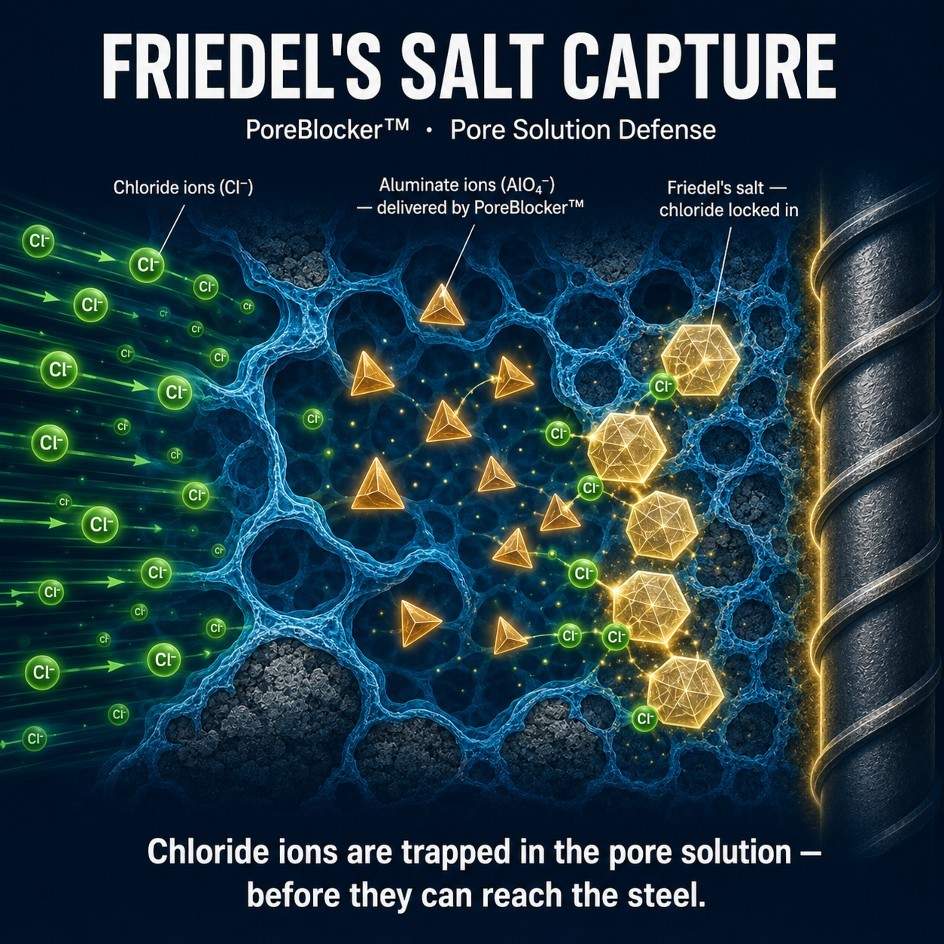
The defense is layered rather than singular. The densified C-A-S-H matrix cuts diffusivity, so chloride moves through it more slowly. The aluminate sites the treatment leaves behind bind incoming chloride as Friedel's salt, holding it away from the steel for as long as pore pH stays above about 9, which is why restoring the alkaline reserve and binding chloride are the same job. There is an electrostatic effect as well: converting free calcium hydroxide into the aluminosilicate network shifts the matrix from a net positive charge, which attracts chloride ions, to a net negative one, which repels them.

Chloride diffusion was measured to ASTM C1556 on a specimen treated with Ceramic System PoreBlocker™ and topped with CeramycGuard™, against untreated concrete of the same mix as the baseline, and came out about 50% lower. That result belongs to the two products working as a stack rather than to either one alone, and ASTM C1556 is named here as the test method, not as a result issued by a laboratory.

The chemistry, illustrated

What happens inside the concrete

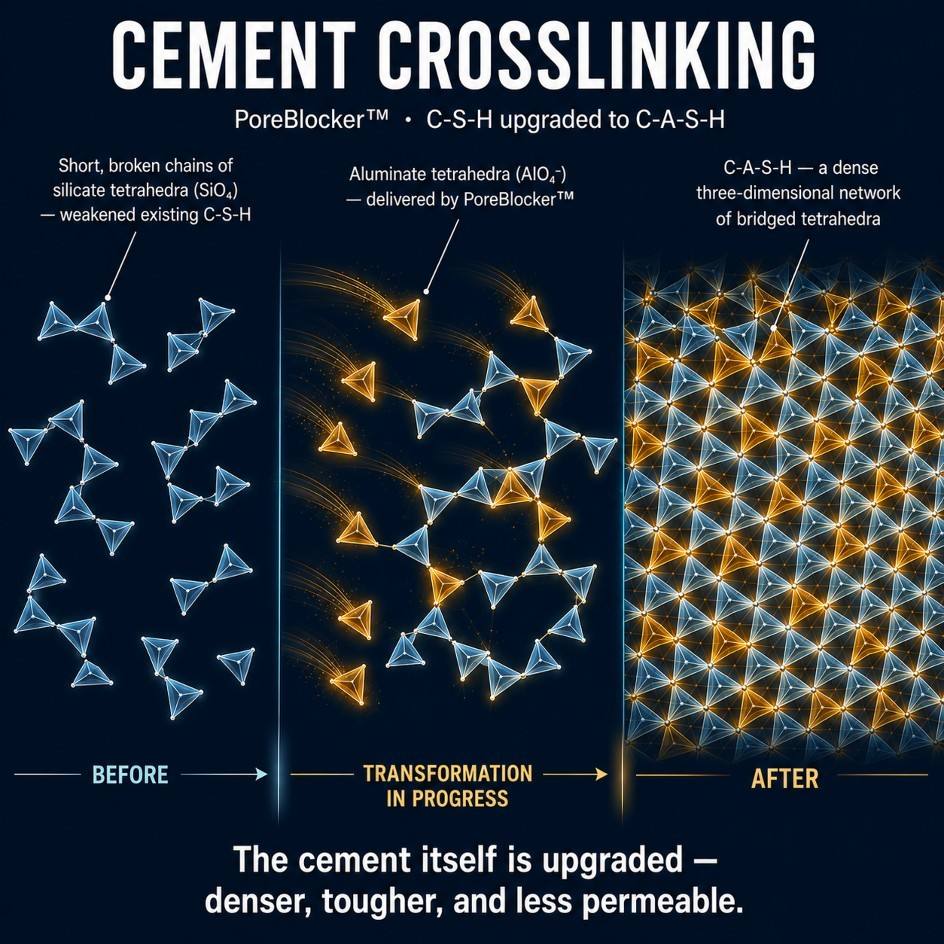
Cement crosslinking diagram, PoreBlocker treatment building a dense C-A-S-H binder network
PoreBlocker penetrating treatment upgrades the cement itself: C-S-H crosslinked into a denser C-A-S-H network.
Friedel's salt diagram, chloride ions captured in concrete before reaching reinforcing steel
Friedel's salt capture: PoreBlocker's chloride binding locks ions in the pore solution before they reach the steel.

Specifying and applying it

One product, one coat, sprayed on

Surface preparation

The concrete must be clean and free of oil, grease and other bond breakers, then pre-wet to a saturated surface dry condition: pores fully saturated, the surface damp, with no standing water left on it. The pre-wet is what carries the colloidal chemistry down into the capillary network instead of letting it react at the face and stop there.

Application

Ceramic System PoreBlocker™ is applied with a low to medium pressure sprayer using a fan tip. There is nothing to mix and only a single coat is required, because one coat achieves the properties. Coverage is approximately 175 sq ft per gallon (16 m² per gallon), and it varies with how porous the concrete is: a weathered, thirsty deck takes more than a dense precast panel.

Conditions

Do not apply below 35°F (2°C) or above 90°F (32°C), and do not apply if rain is forecast within 24 hours. The chemistry is water based and needs its own water, not the weather's.

After application

Allow 24 hours to cure before a topcoat goes on, then rinse away any salts or other contaminants the treatment has pushed to the surface. That rinse is part of the job rather than a tidy up: mobilized salt left on the face is salt sealed back in under the coating.

Handling and packaging

The product is an irritant to skin, so gloves are worn and the safety data sheet governs. It is odorless, with a specific gravity of approximately 1.1 kg/L, and it ships in single plastic gallons (3.8 liters) and in 5 gallon (18.9 liter) pails for ease of handling. Store it in the original sealed containers, out of direct sunlight and away from excessive heat.

Chemistry
Alumina-doped colloidal silica, water based
Substrate
Existing, hardened concrete. Not a steel treatment.
Coats
One. A single coat achieves the properties.
Coverage
Approximately 175 sq ft per gallon (16 m² per gallon), depending on porosity
Equipment
Low to medium pressure sprayer with a fan tip
Substrate condition
Clean and free of oil, grease and other bond breakers, pre-wet to a saturated surface dry condition
Temperature
35°F (2°C) minimum, 90°F (32°C) maximum
Weather
Do not apply if rain is forecast within 24 hours
Before topcoat
24 hours, then rinse away any salts brought to the surface
Odor
None
VOC
Zero
Specific gravity
Approximately 1.1 kg/L
Packaging
Single gallons (3.8 liter) and 5 gallon (18.9 liter) pails
Handling
Irritant to skin. Wear gloves. The safety data sheet governs.

On site

How it goes on

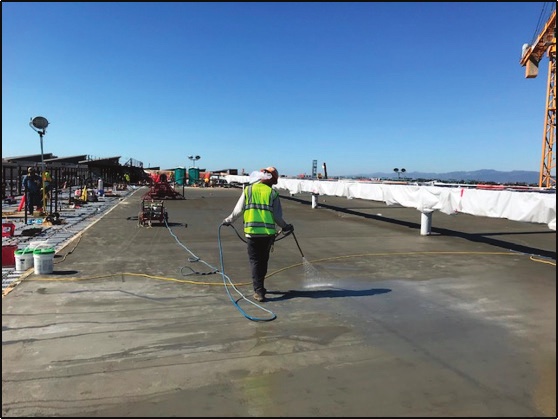
A worker in a high-visibility vest spraying liquid treatment across a large open concrete slab on a construction site under a clear sky
Spray application across an open concrete slab, one coat, low to medium pressure with a fan tip.
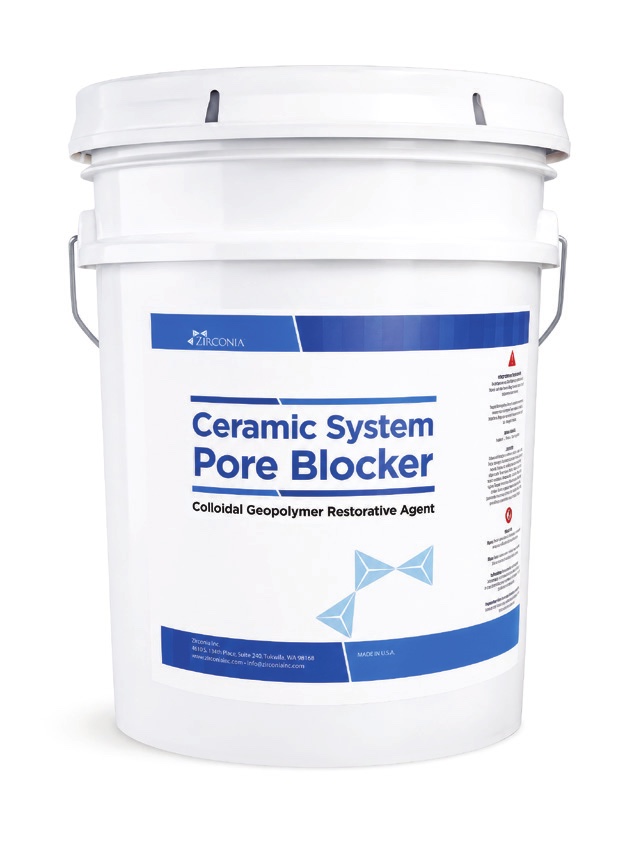
A five gallon white plastic pail of Ceramic System Pore Blocker with a blue and white product label, photographed on a plain background
Supplied in single gallons and in 5 gallon pails. Nothing to mix on site.

Part of the Ceramic System

Designed to work with CeramycGuard™

Ceramic System PoreBlocker™ is the first step in Zirconia's full ceramic treatment system. By densifying the substrate and eliminating contaminants before CeramycGuard™ is applied, the system as a whole delivers a more durable protective barrier. The two products are engineered to work together, and specifying both ensures the ceramic coating has the strongest possible foundation.

The order matters. Treating first means CeramycGuard™ bonds into a denser, contaminant-free, C-A-S-H rich surface rather than into aged paste, and because both sides of that join are built from the same aluminosilicate chemistry, the coating grows into the concrete instead of sitting on it. On a new pour the equivalent first step is ActiveCure™, which is the same chemistry family applied while the concrete is still curing. Ceramic System PoreBlocker™ is the one to specify when the concrete is already hardened and already in service.

Learn about CeramycGuard™

Recommended uses

Where Ceramic System PoreBlocker is specified

Parking structures

Walls and decks in parking garages where de-icing salts and moisture drive ongoing deterioration.

Precast products

Slabs, pipes and other precast elements that benefit from a denser surface before protective coating.

Bridges and civil

Beams, piers and abutments exposed to traffic loads, carbonation and chloride ingress.

Coastal and marine

Seawalls and wharfs in high-chloride environments where the pore network accelerates corrosion.

Water infrastructure

Dams, tunnels, storm drains, water treatment and wastewater treatment structures.

Masonry and retaining

Cinderblock walls, retaining walls, sound barriers and greenhouse walls and floors.

The common thread is existing concrete in a corrosive environment: assets that were built to last decades, that are now weathering faster than they were designed to, and that would otherwise be demolished and rebuilt. Restoration in place is what this chemistry is for, even after years of exposure.

The full product data, cure schedule and surface preparation detail from the technical data sheet are set out on the Ceramic System PoreBlocker™ technical detail page.

Specify Ceramic System PoreBlocker™ for your project.

Request the technical data sheet or talk to our team about preparing your concrete substrate before ceramic coating application.