Carbonation
Carbon dioxide diffuses in and reacts with calcium hydroxide, decalcifying the binder and dropping pore pH from about 12.5 to below 9. Below that point the passive oxide film on embedded steel dissolves and corrosion begins.

Prepare the concrete (Base Layers)
Seal & bond (Surface Barrier)
Protect & finish (Topcoats & Sealers)
Complete systems (Multi-Layer)
Technical detail (Long Form)
Technology
The short answer is yes, and it is the reason most concrete eventually fails. Here is what the pore network actually is, what travels through it, and what can be done about it.
Yes. Concrete is porous. As cement hydrates it leaves an interconnected network of capillary pores running through the hardened paste, so water and everything dissolved in it can travel into the material rather than sit on top of it. That porosity is not a defect in the pour. It is inherent to how cement cures, and it is the route almost every form of concrete deterioration takes.
Concrete is porous with up to 10% void space. The figure matters less than the shape of it: the voids are interconnected rather than isolated, so the pore network behaves as a transport path into the material. Anything that dissolves in water can use it, and the deeper it travels the harder it is to reverse.
Cement does not fill every space it occupies. Hydration consumes water and leaves the remainder as capillary voids threaded through the paste, along with a large reservoir of a weak by-product. Calcium hydroxide, also called portlandite, is left over from hydration at roughly 20% of the cement mass. It is the softest and most chemically vulnerable phase in the matrix, and the pore network delivers water straight to it.
This is why the paste, not the aggregate, decides durability. Aggregate is comparatively dense and inert. The paste holds both the pore network and the phase most willing to react with whatever arrives through it.
Both answers appear in search results because two different things are being described. Concrete as cast is porous. A concrete surface can be made non-porous to liquid by treatment, and the distinction is measurable rather than rhetorical.
CeramycGuard™ cures to a nanostructured surface: pores in the 1 to 10 nanometer range, with essentially no micrometer capillary porosity. Liquid water needs pores wide enough to overcome surface tension, typically over 100 nanometers under environmental pressure, so it cannot be driven in. Water vapor travels as individual molecules of about 0.27 nanometers and still diffuses through the connected nano-mesopore network. The treated surface is non-porous to liquid and breathable to vapor at the same time, which is not a contradiction but a molecular sieve. Dissolved contaminants ride in liquid water, so if the liquid cannot enter, neither can they.
Porosity is not itself the damage. It is the delivery system. Each major deterioration mechanism is a different passenger using the same route.
Carbon dioxide diffuses in and reacts with calcium hydroxide, decalcifying the binder and dropping pore pH from about 12.5 to below 9. Below that point the passive oxide film on embedded steel dissolves and corrosion begins.
Chlorides from de-icing salt or a marine environment migrate through the pore solution, reach the steel, and locally break down its passive layer, which starts pitting. This is ionic migration through the pores, not a surface effect.
In sewers and wastewater structures, bacteria convert hydrogen sulfide into sulfuric acid. That acid attacks calcium hydroxide and the binder, releasing gypsum and silica gel and opening the surface further.
Pore water expands about 9% when it freezes. Every cycle cracks the matrix a little more, which admits more water, which freezes in turn. Saturation is the precondition, and saturation is a porosity problem.
Wear removes the weakest phase first, and on untreated concrete the weakest phase is the portlandite-rich paste at the surface. The wear face is the vulnerable phase rather than the durable one.
Every mechanism above ends the same way. Damaged paste is more porous than sound paste, so each round of damage widens the path for the next. Deterioration accelerates rather than progressing steadily.
At atomic scale, concrete’s durability comes from a three-dimensional network of silicon and aluminum atoms tied together by shared oxygen atoms, known as bridging oxygens. Carbonation, chloride attack, acid, freeze-thaw and sulfate attack all converge on the same endpoint: bridging oxygens break, the network fragments, the matrix loses cohesion, and water and ions move more freely than before. Porosity is how the aggressor arrives; broken bridging oxygens are what it destroys.
That is the useful way to read a porosity problem. Filling voids treats the symptom. Putting the broken network back and then closing the surface treats the cause.
Under the microscope
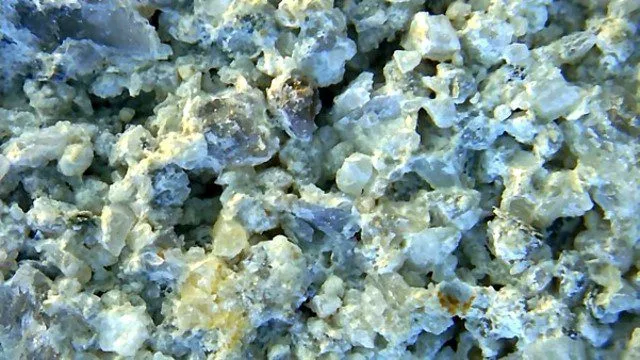
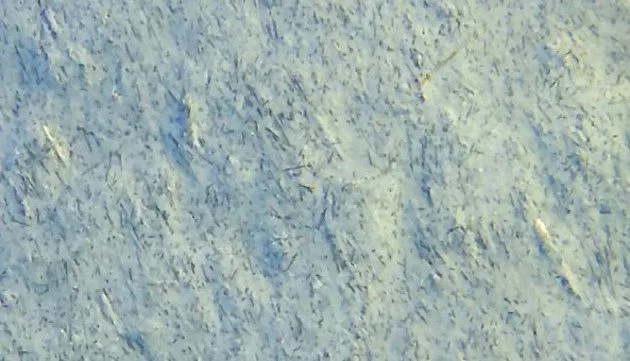
CeramycGuard fills in the surface pores and chemically stabilizes the cement paste. Rainwater and other contaminants can no longer degrade the concrete from within.
What to do about it
Zirconia Inc treats porosity as two jobs in sequence, not one coating decision. The order is the whole point: chemistry that has to travel through the pore network must go in before anything closes that network.
Ceramic System PoreBlocker™ is applied to existing, cured concrete. It penetrates the pore network and reacts with the free portlandite and the calcium-rich, high-pH pore solution, converting the weakest phase of the matrix into durable calcium aluminosilicate hydrate, or C-A-S-H. It also bonds into existing binder and upgrades it. This is chemical regeneration of the binder phase, not pore filling.
On new concrete the same job belongs to ActiveCure™, applied in the first days after placement so the slab matures denser than ordinary curing produces, and so CeramycGuard can follow in 5 to 7 days instead of the traditional 28-day wait.
CeramycGuard™ is a ceramic surface treatment that condenses into a continuous bridging-oxygen network and runs that same chemistry into the restored matrix underneath. It grows into the concrete rather than sitting on it, so there is no glue line and no separate interface to fail. The result is the nanostructured surface described above: closed to liquid water and the salts and acids dissolved in it, open to water vapor leaving the slab.
Because it is inorganic, there are no carbon-based bonds for ultraviolet light to break, so the surface is intrinsically UV-stable rather than UV-protected.
Once CeramycGuard seals the surface, no further colloidal chemistry can penetrate. The interior is locked as it stands for the life of the structure. That is one window, not a recurring option, and it is the reason a specifier deciding to skip the penetrating stage on an aged, chloride-loaded or carbonated slab is making a permanent decision rather than a scheduling one. If the interior needs restoring, it has to happen before the surface closes.
Tell our technical team the exposure, the age and the condition, and they will tell you whether it needs the penetrating stage, the surface stage, or both.
The problems go far beyond visible surface deterioration. Porosity quietly destroys critical infrastructure in ways that are rarely noticed until failure is imminent.
Chlorine is essential for sanitation in drinking-water systems, killing microbial contaminants before water reaches the tap. But chlorine penetrates the pores of concrete storage reservoirs, dissolves the cement paste, and corrodes the reinforcing steel rebar. Reservoirs around the world are failing from the inside out as a direct consequence.
Bacteria enter the pores of concrete sewer pipes and structures, where they find food, water, and shelter. Acid-producing bacteria thrive in that habitat, and the acids they emit eat through both concrete and steel. Sanitary sewer infrastructure is deteriorating globally because of this mechanism, at enormous cost to public utilities.
In food-processing plants and animal grow facilities, porous concrete floors and walls provide habitat for pathogenic bacteria. Once established inside the pore network, those bacteria cannot be cleaned out by standard sanitation. They re-enter the food supply, creating persistent food-safety risks that routine cleaning cannot resolve.
Most products sold for porous concrete do one of three things, and none of them rebuilds the binder.
A ceramic surface treatment is the option that rebuilds the binder as C-A-S-H, gives the matrix an active chloride-binding capacity it did not have, and bonds a ceramic surface through one continuous chemistry. If you want the chemistry compared side by side, see colloidal silica versus colloidal aluminate-silicate, and for the bonding argument in full, see chemical bonding versus adhesion.
A municipal water reservoir in Sacramento, built in 1939, had carbonation, salt ingress and active reinforcement corrosion. Ceramic System PoreBlocker™ was applied first to consolidate the substrate from within, then CeramycGuard™ sealed the surface. The work reversed active corrosion and protected the concrete against further attack, and it is documented in the water reservoir project spotlight.
At Tyson Foods, a below-grade mechanic shop with bare concrete masonry walls was damp from subgrade groundwater and growing mold. Concrete masonry is highly porous with patchy surface calcium, so it takes the full system: CeramycGuard™ first to mineralize the face and present a uniform surface, then BulletProof™ locking into it. Tyson’s own verdict on the result was that it "could not have been solved by any other technology". More cases are in the project spotlights.
Common questions
Concrete as cast is porous. A concrete surface can be made non-porous to liquid by treatment. CeramycGuard™ cures to pores in the 1 to 10 nanometer range with essentially no micrometer capillary porosity, and liquid water needs pores wider than roughly 100 nanometers to be driven in, so it stays out while water vapor at about 0.27 nanometers still diffuses through.
Yes, and the cement paste is the porous phase that matters. Aggregate is comparatively dense. The paste carries the capillary network and also carries concrete’s weakest phase, portlandite, left over from hydration at roughly 20% of the cement mass.
Concrete is porous with up to 10% void space. What matters more than the number is that the voids are interconnected, so they act as a transport path rather than as isolated bubbles.
Yes, in two stages. Ceramic System PoreBlocker™ penetrates and rebuilds the binder of existing concrete, then CeramycGuard™ forms a ceramic surface that grows into the restored matrix. On new concrete ActiveCure™ does the first stage as the slab cures.
Not with this chemistry. The cured surface blocks liquid water while remaining permeable to water vapor, so internal moisture can still leave the slab. That is why a ceramic surface treatment does not produce the blistering and delamination associated with impermeable organic coatings over damp concrete.
It is half the reason. Coatings that cannot bond chemically to concrete are given grip by grinding the surface open, which makes it more porous, and vapor moving through that porous slab then pushes at a coating that is only stuck on. See why concrete coatings peel for the failure mode in full.
Send us the exposure, the age and the condition, and our technical team will tell you which stages the substrate actually needs.