Warehouse and data center slabs
Large floor pours where curling at the edges and shrinkage cracking across the field are the defects that cost most to put right later.

Prepare the concrete (Base Layers)
Seal & bond (Surface Barrier)
Protect & finish (Topcoats & Sealers)
Complete systems (Multi-Layer)
Technical detail (Long Form)
Prepare the concrete
Alumina-doped colloidal silica that cures and prepares fresh concrete for Zirconia's ceramic surface treatments in days, not weeks, while durably densifying the surface against moisture and chemical attack.
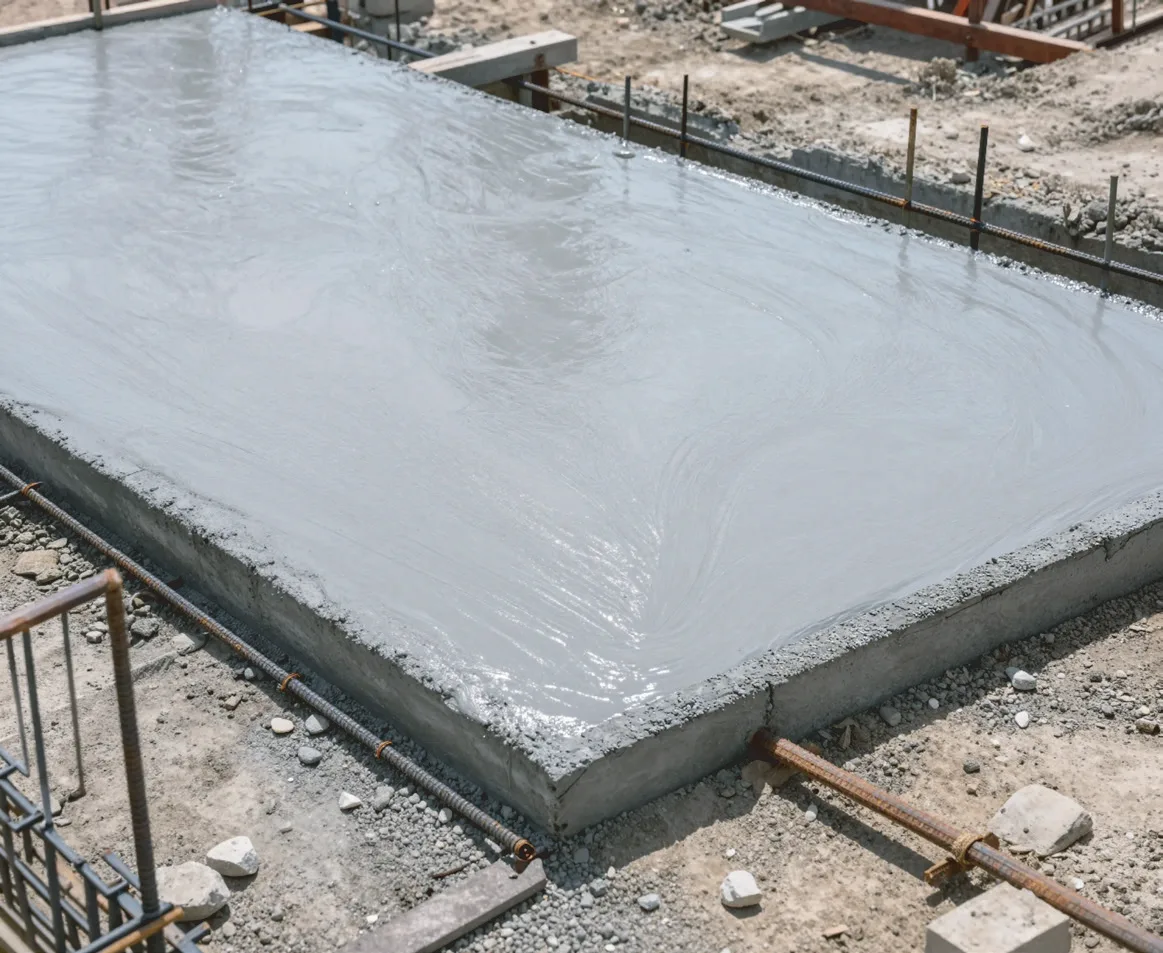
Zirconia's ActiveCure™ uses alumina-doped colloidal silica to create an optimal substrate for Zirconia's ceramic surface treatments. Used at walk-on hardness (once the concrete is firm enough to walk on), ActiveCure allows CeramycGuard™ to be applied in just 5-7 days, instead of the 28 days traditional coatings require.
As the concrete cures, ActiveCure builds a denser, less permeable surface that performs comparably to moisture-cured concrete, with reduced drying shrinkage. Because it uses no curing agents, nothing has to be removed before the coating system is applied.
Used together, ActiveCure and CeramycGuard™ form the system of choice for waterproofing above-grade concrete and CMU where elastomeric systems are not required, delivering long-term protection while improving the conditions for concrete performance.
It is a water-based treatment with zero VOC, stated here for this product and not as a claim across the range.
ActiveCure documents and specifications The specification table and the product documents, on one page.
The problem
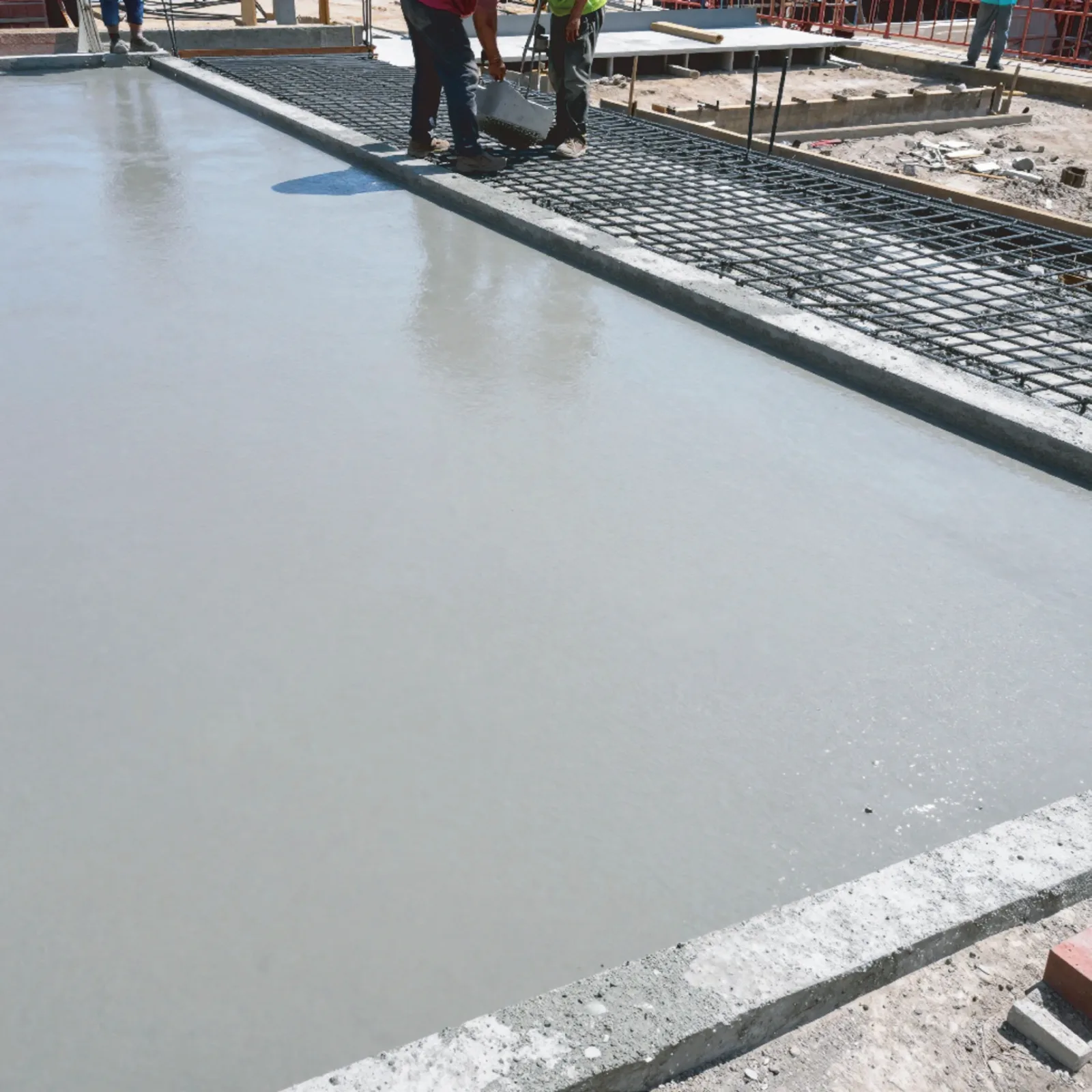
Cement hydration needs the mix water, and for the first 24 hours that water is in a race with wind, heat and low humidity. Lose it and the concrete cures thirsty. Internal tensile stresses build faster than the young paste can resist them, and the slab answers with plastic shrinkage cracking, crazing across the surface, and curling at the edges.
None of those defects stays cosmetic. Every one of them is a permanent route for water, road salt and carbon dioxide to get into the concrete later, which is why early-age moisture loss shows up years afterwards as a corrosion problem rather than a finishing problem.
Conventional curing tries to hold the water in from the outside, with membranes, blankets or continuous wetting. All of that takes labor and takes time, and a curing compound leaves something on the surface that has to be ground or stripped off again before anything protective can be applied.
ActiveCure works from inside the paste instead. Sprayed on at walk-on hardness, it seals the slab using the concrete's own chemistry in about 40 minutes, so the water stays where hydration needs it.
How it works
ActiveCure enters the capillary network of fresh concrete at walk-on hardness, reaching deep before the surface closes. It delivers billions of reactive aluminate and silicate seed sites into every square millimeter of the slab.
The alumina-doped colloidal silica reacts with the portlandite generated as the cement hydrates, converting it into calcium aluminosilicate hydrate (C-A-S-H), the durable form of the binder. The reaction runs at roughly 50 times the rate of standard hydration, which is what lets it beat the evaporation clock.
The treated concrete develops a denser surface with reduced permeability and drying shrinkage, comparable in performance to properly moisture-cured concrete, and hard and free of dust from the day it is handed over.
Because no curing compounds are needed, the surface is ready for CeramycGuard™ application in 5-7 days. No stripping, grinding or surface prep to remove curing agents.
The chemistry
Cement hydration produces calcium hydroxide, also called portlandite, as a by-product. It is roughly 20 percent of hydrated cement paste by mass, which works out at about 5 to 7 percent of the total mass of a structural mix, or 200 to 285 pounds in every cubic yard. None of it carries load. It is soluble, it is the first thing an acid finds, and it is what carbon dioxide consumes during carbonation. A meaningful share of the binder in an ordinary slab is therefore a weakness waiting to be exploited.
The reactive sites ActiveCure delivers meet the free calcium and the high-pH pore solution and convert that portlandite into C-A-S-H. C-A-S-H is the same structure as the C-S-H ordinary cement forms, with aluminum substituted into key positions in the silicate chain. That single change does four things: it lengthens and cross-links the chains into a network rather than a set of chains, it locks calcium in tightly so it resists leaching, it slows carbonation, and it creates the aluminate sites that trap chloride.
Because the treatment converts the calcium hydroxide rather than coating over it, Zirconia's position, in Benjamin Cook's own words, is that the treated surface is immune to carbonation. There is nothing left for carbon dioxide to consume.
Chloride is handled chemically rather than by exclusion alone. The aluminate sites in C-A-S-H bind free chloride into Friedel's salt, immobilizing it in the matrix instead of letting it migrate towards the reinforcement. That binding depends on alkalinity, and it is durable because the alkalinity is durable: C-A-S-H holds the pore solution at pH 11.5 to 12.5, the range in which embedded steel stays passivated.
The same flood of reactive material densifies the interfacial transition zone, the porous band of paste that forms around every piece of aggregate. The ITZ is where microcracking starts in a normal slab, and where those microcracks later join into something structural, so densifying it early removes a failure path rather than sealing over it. Lower porosity also keeps water absorption down, which matters for freeze-thaw: the damage mechanism runs away above roughly 91 percent saturation, where internal pressures exceed 4,000 psi, and a matrix that cannot take on that much water cannot generate those pressures.
Application
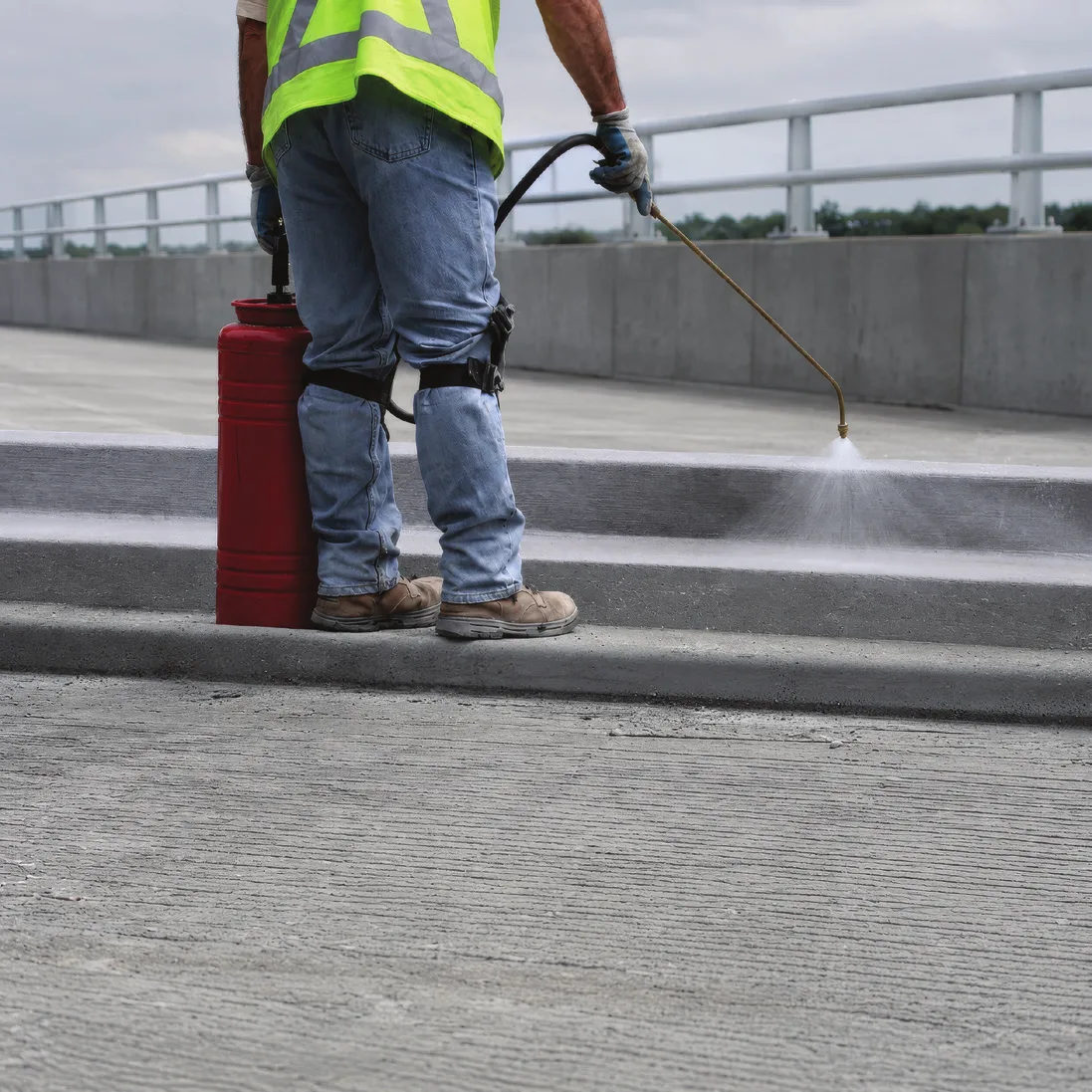
Timing is the one thing worth getting right. ActiveCure goes on at early walk-on, once the slab holds a footprint without marking, typically 4 to 12 hours after the pour. It is sprayed evenly using a low to medium pressure sprayer with a fan tip, in a single application, with no rinsing afterwards.
Coverage is about 200 square feet per gallon, or 18.6 square meters per gallon. Apply between 35°F and 90°F (2°C to 32°C), and not if rain is forecast within 6 hours. ActiveCure is an irritant to skin, so gloves are worn.
The product ships in single gallons of 3.8 liters and in 5 gallon pails of 18.9 liters, and stores for two years in the original sealed containers, kept out of direct sunlight and excessive heat.
It can also be applied after initial set, to hardened or young concrete, purely to densify the surface. That works and it is a legitimate use, but the full curing benefit belongs to the early plastic application, so the earlier window is the one to plan for.
Recommended uses
ActiveCure is specified for curing and strengthening freshly placed concrete: slabs, floors, pavements, roads, decks and vertical shotcrete surfaces.
Large floor pours where curling at the edges and shrinkage cracking across the field are the defects that cost most to put right later.
Flat work placed in wind and sun, where surface crazing follows fast evaporation and water curing is awkward to keep up.
Working slabs that need to be hard and free of dust as soon as they are handed over, not weeks afterwards.
Faces where holding moisture in during the cure is difficult by any conventional method, because gravity works against every blanket.
Walls and decks in garages where de-icing salts and moisture work together to accelerate concrete deterioration.
Slabs and pipes benefit from early ActiveCure application, cutting the wait before protective coatings can be applied.
Beams, piers and abutments exposed to chloride, carbonation and constant weathering.
Seawalls and wharfs in chloride-rich coastal environments where reinforcement corrosion is a constant threat.
Dams, tanks, tunnels and treatment facilities where durably reducing permeability is essential to long-term performance.
Where it fits in the system
Zirconia's sequence for new concrete runs ActiveCure at walk-on hardness, CeramycGuard™ at 5 to 7 days, and a hybrid inorganic-organic topcoat such as BulletProof™ or Fortress XD™ at day 21. Bypassing the traditional 28-day wait before a protective coating can go on saves about a week of contractor time on the critical path, which is usually the argument that carries a project schedule.
ActiveCure and Ceramic System PoreBlocker™ come from the same chemistry family. The difference is life-cycle stage. ActiveCure is specified for new placement, where it joins the hydration reaction as it happens. PoreBlocker is specified for existing concrete, where it penetrates the pore network of a cured, aged substrate and rebuilds the matrix that time, carbonation or chloride exposure has degraded.
It is a curing and densifying treatment, not a structural repair and not a coating. It does not replace mix design, reinforcement detailing or joint layout, and it will not rescue a slab that has already lost its water. The deep penetration figures published for this chemistry belong to weathered, in-service concrete with developed capillarity, and are not claimed for a fresh pour. The scope of the product is concrete.
Questions
At early walk-on hardness, once the slab is firm enough to walk on without leaving footprints, which is usually 4 to 12 hours after the pour. It is sprayed evenly with a low to medium pressure sprayer and a fan tip, in a single application, with no rinsing afterwards and nothing to strip off later. Apply between 35°F and 90°F, and not if rain is forecast within 6 hours. It is an irritant to skin, so gloves are worn.
Yes. ActiveCure™ may be applied to hardened or young concrete after initial set, purely to densify the surface. That is a legitimate use, but the full curing benefit belongs to the early plastic application, so the earlier window is the one worth planning for. For aged, in-service concrete that needs its binder rebuilt rather than protected on the way up, Ceramic System PoreBlocker™ is the product specified.
CeramycGuard™ can be applied 5 to 7 days after placement instead of waiting the traditional 28 days, and the hybrid topcoats, BulletProof™ and Fortress XD™, go on at day 21. In practice that takes about a week off the critical path.
Indirectly, and that is the right order. The cement binder degrades first and the steel corrodes second, so protecting the binder is what protects the bar. C-A-S-H holds the pore solution in the pH 11.5 to 12.5 band that keeps steel passivated, and its aluminate sites bind incoming chloride as Friedel's salt, which is stable while that alkaline reserve holds. The scope of the product itself is concrete.
Download product documentation
ActiveCure documents and specifications Coverage, application window, packaging and storage, set out as a table.
Request the technical data sheet or talk to our team about using ActiveCure with CeramycGuard™ on your concrete asset.