
Products
Prepare the concrete (Base Layers)
Seal & bond (Surface Barrier)
Protect & finish (Topcoats & Sealers)
Complete systems (Multi-Layer)
Technical detail (Long Form)
Prepare the concrete (Base Layers)
Seal & bond (Surface Barrier)
Protect & finish (Topcoats & Sealers)
Complete systems (Multi-Layer)
Technical detail (Long Form)
Technology
A deck has to keep salt out and keep grip. Almost everything that delivers the first takes something off the second. Here is why, and how the conflict is resolved.
You treat the concrete instead of covering it. A bridge deck is asked for two things that usually pull against each other: a surface that de-icing salt cannot get through, and a surface a tire can grip in the rain. Anything laid on top of the deck, a membrane, an overlay, a film-forming sealer, delivers the first by changing the second. The way out of that trade is to put the protection inside the concrete rather than on it. A penetrating treatment soaks into the pore network, reacts with the cement paste, and closes the route chloride travels, and because it leaves no film behind, the driving surface keeps exactly the texture it already had. That is the stated design goal of ConcreteCare CS-42™: fight salt corrosion without changing the friction coefficient at the surface.
Skid resistance is a safety property of a deck, and it lives in the texture of the concrete itself. A driver braking on a wet bridge is relying on that texture to move water out of the contact patch and give the tire something to bite. Fill it, smooth it, or lay something slicker over it, and the friction coefficient changes. On a bridge that is not a cosmetic change, which is why deck protection is a harder problem than protecting a wall or a tank.
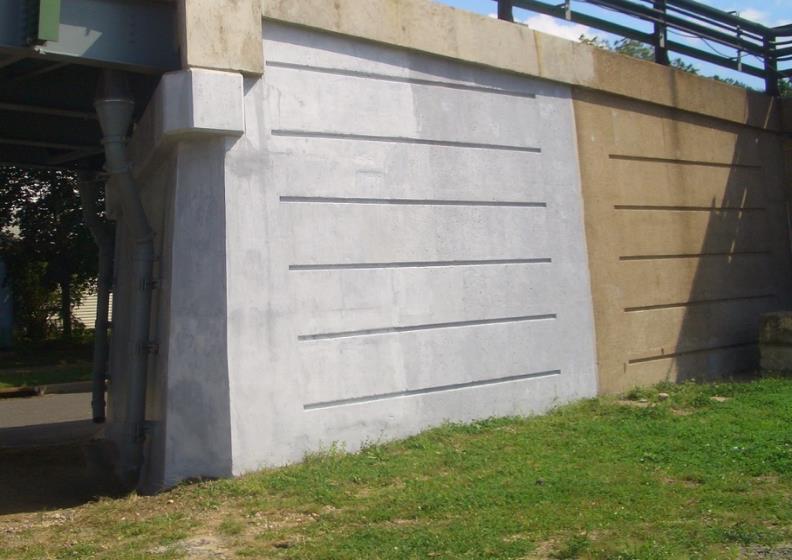
Zirconia’s own work shows the contrast. A freeway supporting wall in New Jersey, painted by the state DOT and hit with freeze-thaw and de-icing salt every winter since around 2004, is still undamaged. That wall only has to survive the exposure. A deck in the same climate has to survive it and be braked on, in the wet, at speed.
Concrete is porous, with up to 10% void space, and those voids are interconnected rather than isolated. Salt dissolves in meltwater and the chloride ions migrate through that pore solution toward the reinforcing steel. When they arrive they locally break down the passive oxide film that keeps the steel stable, and pitting corrosion starts. Corroding steel occupies more volume than sound steel, so it pushes outward, and that pressure cracks and spalls the concrete around it.
Carbonation runs alongside it. Carbon dioxide diffuses into the same pore network and reacts with the calcium hydroxide in the paste, dropping pore pH from about 12.5 to below 9. Below that point the passive film on the steel dissolves whether chloride has arrived or not. Both mechanisms are compounding: damaged paste is more open than sound paste, so every round of damage widens the path for the next.
So a deck does not fail because the concrete ran out. It fails because the steel inside it corroded, and the concrete was what should have kept the aggressor away from that steel.
The instinctive fix is additive: put a barrier between the salt and the concrete. A bonded membrane, an asphalt or polymer overlay, an epoxy or urethane film. Each of them works while it is intact, and each of them brings the same three problems to a deck.
There is a fourth cost that is easy to miss. Organic coatings cannot bond chemically to concrete, so installers open the surface by shot blasting or grinding to get mechanical grip. That makes the concrete more porous than it started, and if the coating later peels, the deck is left more exposed to chloride than if it had never been coated.
When cement hydrates it leaves behind calcium hydroxide as a by-product. Benjamin Cook, who formulates Zirconia’s chemistry, puts it at 20 to 25 percent of the cement. It is soluble, it does no structural work, and it is the first thing carbonation and acid attack. A meaningful share of the binder in every deck is therefore a weakness waiting to be found.
The CS-42 chemistry reconstructs the concrete at that level. It converts the calcium hydroxide into calcium aluminous silicate hydrate, the durable aluminosilicate binder phase rather than the soluble leftover, and then, in Benjamin’s description, locks itself down through three sequential mechanisms. What that conversion buys is not one defense but several, all of them below the surface:
Every one of those happens inside the deck. None of them adds anything to the top of it. The treated concrete is still the wear surface, still the friction surface, still the thing the tire touches. Benjamin describes holding a treated piece of concrete under water for an hour and finding it still had not wet through, with no loss of friction, which is the whole argument in one demonstration: the water is being stopped by the concrete, not by something stuck to it.
With no coating on the driving surface, there is nothing for traffic, plows or studded tires to wear through, and no membrane to blister or debond when vapor moves up out of the slab. The deck goes on releasing internal moisture the way untreated concrete does, and no recoat cycle is imposed by a sacrificial layer reaching the end of its own, much shorter, life.
The product built to this brief
ConcreteCare is a brand in its own right rather than a Zirconia-badged product line. It carries the sealer systems, which serve a market of their own, while the rest of the Zirconia range is core infrastructure work: parking structures, wastewater, restoration of major assets. CS-42 is the ConcreteCare system written for infrastructure exposure.
It is a water-based, two-stage penetrating treatment with no odor and no flash point. Stage 1 soaks deep into the deck, fills micro-cracks and rebuilds the concrete from within, so an aged deck can be restored in place instead of demolished. Stage 2 is a surface densifier that penetrates and seals without forming a film, which is where the friction requirement is met rather than traded away.
Coverage is about 175 sq ft per gallon per stage, and the system installs in two brief closures rather than one long one: two hours for stage 1, a week carrying traffic while it cures, then an overnight closure the following weekend for stage 2, reopening within 12 hours or less. On a live structure that is usually what decides the project.
The conversion at the heart of CS-42 is the move Zirconia makes everywhere: take the weakest phase in the cement paste and turn it into the strongest one. On coastal and marine structures the same logic runs through the Ceramic System PoreBlocker™ and CeramycGuard™ stack, and the ionic detail of that defense is set out in how to stop salt corrosion in concrete. For the porosity underneath all of it, start with is concrete porous.
One last thing, since specifiers always ask. The 42 is not a formulation code or a product generation. It is a Hitchhiker’s Guide reference: the answer to life, the universe and everything. Benjamin named it himself.
Common questions
It does if the product forms a film, because the tire then meets the film instead of the concrete. It does not if the product penetrates. ConcreteCare CS-42™ is a two-stage penetrating treatment that leaves no coating on the driving surface, so the deck keeps its existing texture and its skid resistance. Benjamin Cook, who formulates the chemistry, describes the design goal as fighting salt corrosion without changing the friction coefficient at the surface.
Salt dissolves in meltwater and the chloride travels through the concrete pore network to the reinforcing steel, where it breaks down the passive film that protects the steel and starts pitting. Corroding steel expands, and that expansion cracks and spalls the concrete around it. The deck does not fail because the concrete wore out. It fails because the steel inside it corroded.
A membrane or an overlay is a separate layer bonded on top of the concrete, so it brings an interface that can debond, a surface that wears under traffic, and its own friction behavior, which becomes the deck’s friction behavior. A penetrating treatment adds no layer at all, so there is nothing between the tire and the concrete and nothing to blister or wear through.
It converts calcium hydroxide, which Benjamin Cook puts at 20 to 25 percent of the cement, into calcium aluminous silicate hydrate. That single change densifies the capillary network chloride travels through, creates aluminate sites that bind incoming chloride as Friedel’s salt, holds pore-water pH in the 11.5 to 12.5 range that keeps steel passivated, and shifts the matrix from a net positive to a net negative charge so chloride is repelled rather than drawn in.
An aged deck that has begun to deteriorate can be treated in place rather than demolished and rebuilt, which is the usual route. The limits are honest ones: micro-cracks are filled by the chemistry, but cracks beyond that width, and any actively moving or structural crack, need structural repair before a protective treatment goes on.
Two brief closures, with traffic running in between. Stage 1 is a two-hour closure to apply PoreBlocker, after which the deck reopens and cures for a week under traffic. Stage 2 is an overnight closure the following weekend for wash-down and CS-42, and the deck reopens within 12 hours or less depending on the area coated. On a live structure that is usually what decides the project, because closing a bridge costs more than treating one.
Tell our technical team the structure, the exposure and its current condition, and they will tell you whether a penetrating treatment is the right specification for it.