
Products
Anti-corrosion
Industrial & floors
Curing agent
Concrete sealers
Residential
Anti-corrosion
Industrial & floors
Curing agent
Concrete sealers
Residential
Blog
A below-grade mechanic shop, subgrade groundwater forcing through CMU block walls, corroding equipment and breeding mold. Zirconia's ceramic surface technology stopped it.
Large food-processing campuses push infrastructure underground to keep operations compact. That efficiency comes with a real risk: subgrade groundwater finds every gap in a CMU (concrete masonry unit) block wall, and once it gets through, the consequences compound fast. At this Tyson Foods facility, the below-grade mechanic shop was bearing the full weight of that risk.
Water was infiltrating through the block walls at multiple points. The shop housed welding equipment and other machinery that cannot tolerate sustained moisture exposure. Corrosion had begun to take hold on metal surfaces. Mold had followed the moisture, creating hygiene concerns for both the facility and the engineering and maintenance staff who worked there every day.
The challenge was not simply cosmetic. Tyson Foods needed a solution that could seal the walls permanently from the positive-pressure side of groundwater, resist the alkalinity and moisture of a concrete masonry substrate, and hold up in an active commercial facility without shutting down operations for weeks.
Standard waterproofing membranes and epoxy coatings are adhesion-based. They bond to the surface rather than becoming part of it. In a below-grade CMU environment, that distinction matters enormously.
Hydrostatic pressure from subgrade water pushes outward from the wall face. An adhesion-based coating sitting on top of that surface will eventually lose the battle, blistering, delaminating, and allowing water to re-enter, often in worse concentrations than before. Epoxy-based products are also susceptible to saponification when in contact with alkaline concrete and sustained moisture, breaking down the bond over time.
A permanently effective solution needs to work differently at the chemistry level.
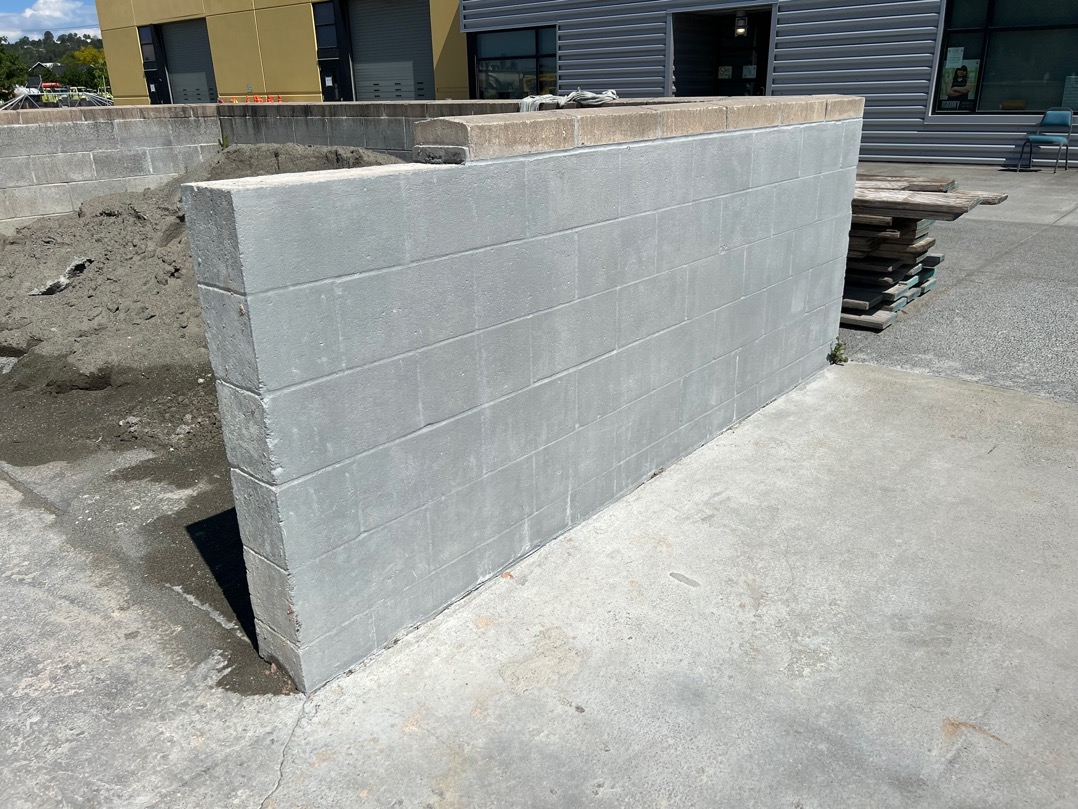
Zirconia applied its CeramycGuard and BulletProof system to the CMU block walls throughout the below-grade space. CMU is highly porous with a patchy surface, so CeramycGuard goes on first: it mineralizes the block face, fills the open capillary structure and builds a uniform, calcium-aluminosilicate-rich ceramic surface. BulletProof, a hybrid (inorganic-organic) topcoat, then chemically locks into that surface and adds a dense, waterproof, chemical-resistant barrier. The bond is to an engineered ceramic surface, not to raw block.
Because the bond is chemical rather than mechanical, it cannot be hydrostatic-pressure- lifted. Groundwater pushing from outside the wall cannot wedge itself between coating and substrate the way it would with a membrane or epoxy. The treated surface becomes, in practical terms, a single material: dense, non-porous, and sealed against liquid ingress from any direction.
BulletProof is formulated to stand up to the alkaline environment of a wet CMU wall, resisting the breakdown that degrades epoxy coatings over time. Once applied and cured, it stays bonded.
The treatment addressed every failure point the facility was experiencing:
Tyson Foods confirmed that this project could not have been solved by any other technology they had evaluated.
The Tyson project is representative of a category of problem that appears regularly across large food-processing campuses: infrastructure built to serve high-output production facilities, operating in conditions that accelerate concrete and masonry degradation, and subject to hygiene and food-safety standards that make "tolerate the damage" a non-starter.
Food-processing facilities face particular constraints that make most conventional coating approaches unsuitable. The chemicals used in cleaning cycles, the temperature swings between refrigerated zones and ambient areas, the humidity generated by processing operations, and the strict food-contact-adjacent hygiene requirements all narrow the field of viable materials considerably.
Zirconia's inorganic ceramic chemistry sits outside the categories that those constraints eliminate. The coatings do not contain organic binders that break down under cleaning chemistry, do not crack under thermal cycling, and present a sealed, hard surface that is straightforward to clean and inspect.
Projects like this one at Tyson Foods have built Zirconia's presence with major food companies. Each difficult, specific problem solved with a demonstrable result adds to the technical credibility that opens doors to the next facility.
This project used the CeramycGuard and BulletProof system: the inorganic CeramycGuard base that bonds to and seals the masonry, finished with the BulletProof hybrid topcoat for moisture and chemical resistance. For food-processing facilities with corrosion and waterproofing requirements, this sits within the broader TruComposite system, which can address floors, drains, and other infrastructure surfaces in the same facility in a coordinated treatment program.
For technical specifications or to discuss a below-grade or food-processing waterproofing project, contact Zirconia's technical team directly.
Project result
If you have a below-grade space, food-processing facility, or masonry structure losing the battle against groundwater, talk to our technical team about a ceramic-system solution.